
Getting to know your first Thai word
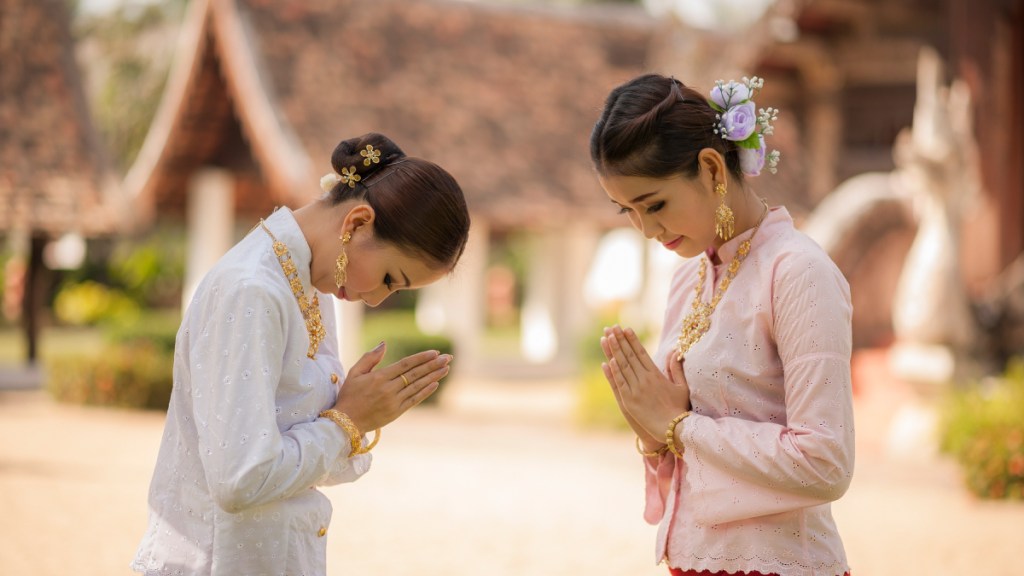
Sawatdee kha! The Thai greeting is often the first phrase a tourist hears upon landing in Thailand. While most vacationers know how to say “Hello” in Thai, few are aware of the meaning behind the word. What exactly do Thais convey when they greet each other (and us, foreigners) on the street, in the office, and at home? Let’s delve into it now.
“Sawatdee” is how the greeting sounds, with the most common romanization of the spelling being “sawasdee” or “sawasdi.” The latter is quite close to the original “svasti” from Sanskrit, the sacred language of Hinduism. Just as Thai, many English words also share roots with Sanskrit, as English belongs to the same group of Indo-European languages.
The latter is quite close to the original “svasti” from Sanskrit, the sacred language of Hinduism.
“Svasti” in Sanskrit encompasses the meanings of well-being, goodness, success, and prosperity. Thus, when Thais say “sawatdee,” they are expressing wishes for all good things in the broadest sense. For Thai speakers, this is additionally emphasized by the “dee” ending, which, as a standalone word, means “good.”
While “sawatdee” is an ancient word, its usage as a general greeting is relatively new. It was ordained only in the 1940s by Plaek Phibunsongkhram as part of his efforts to unify Thai culture. Before that, its use was limited to official documents.
Do not be surprised that the modern Thai “sawatdee” sounds a bit like “swastika”. This is no coincidence, as before the 20th century, the swastika was a symbol of auspiciousness and good luck and is still perceived this way in India.
Having explored the etymology, let’s now return to the use of “sawatdee” as a modern Thai greeting. As you may have noticed, Thais say either “sawatdee kha” or “sawatdee khrab” when they greet each other, not just “sawatdee” alone. Both are particles added for politeness, with “khrab” used by males and “kha” used by females. The choice depends on the gender of the speaker and not the addressee.
These two particles are arguably the most common short words in the entire Thai vocabulary, as Thais add them to literally every phrase to show politeness and often use them instead of “yes” or “indeed.”
“Will you call me later tonight?” a young man might ask his girlfriend.
“Kha. Will you be home at 8 p.m.?” she might reply.
“Kap,” he may answer with an even shorter version of “khrab.”
Many foreign residents of Thailand quickly incorporate “khrab/kap” and “kha” into their own speech and continue using them even outside of Thailand, speaking to a 7-Eleven cashier in Malaysia or a restaurant waiter in Hong Kong. Luckily, a foreigner’s strive for politeness can hardly offend anybody abroad. It just conveys where the person resides and acts as an extra proof of Thainess being positively contagious.
 Real Life in Phuket Magazine